
TV twinlead J-pole antenna construction
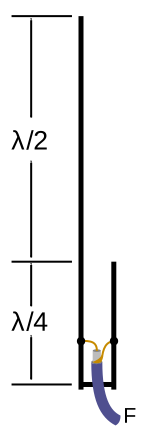
Members learned to build a J-pole from 300-ohm TV twinlead — one of the most effective and inexpensive 2m antennas for a go-kit or home station, following the published Harford County ARES construction guide. Background on the J-pole's history and why it earns its place in ARES go-kits below.
What the J-pole actually is
A J-pole is a vertical antenna built around an end-fed half-wave radiator with a quarter-wave matching stub at its base — together forming the J-shape that gives the design its name. The half-wavelength of wire at the top does the radiating; the quarter-wave shorted stub at the bottom acts as an impedance transformer that brings the very high feed-point impedance of an end-fed half-wave (typically a few thousand ohms) down to the 50 Ω that a coax-fed transmitter wants to see.
The transmitter is connected somewhere along the matching stub — typically about an inch and a half above the short for a 2 m antenna — and the position is adjusted until SWR is minimized.
The whole thing is vertically polarized, omnidirectional in azimuth, requires no radials, and produces a low-angle radiation pattern well suited to terrestrial VHF work — exactly what an ARES operator wants on 146 MHz.
A surprisingly old idea
The basic geometry traces back to Hans Beggerow in 1909, who patented an end-fed half-wave antenna with an open-wire matching section for use on Zeppelin airships. Because it trailed behind the airship rather than needing a counterpoise structure, it was a practical fit for a moving aircraft. That original antenna became known as the Zepp (or Zeppelin antenna).
After WWII, amateur radio operators rotated the Zepp 90° and stood it up vertically — replacing the trailing-from-an-airship use case with an “antenna you can hang in your back yard.” That ground-based vertical version is the J-pole (or J-antenna) we know today. A close cousin, the Slim Jim, was developed by Fred Judd (G2BCX) in the 1970s and folds the radiator back on itself for a shorter overall structure with a slightly tighter takeoff angle.
Performance
Compared to other common 2 m verticals:
| Antenna | Typical gain | Radials? | Notes |
|---|---|---|---|
| Quarter-wave ground plane | ~−1 dBi | Required (3–4) | Cheapest, but needs radial structure |
| Half-wave J-pole | ~0 to +3 dBi | None | Single radiator, end-fed, ground-independent |
| 5/8-wave vertical | ~+3 dBi | Required | Lower takeoff angle than 1/4-wave |
| Collinear (e.g. dual-band 2× 5/8) | +5–7 dBi | Sometimes | More complex; commercial only |
The J-pole punches above its complexity weight — its single half-wave radiator is just as effective as a half-wave dipole, which is the reference antenna gain in real-world 2 m repeater work. You don’t gain dB versus a dipole, but you don’t lose them either, and you trade away the dipole’s horizontal mounting for a vertical that fits the polarization the rest of the 2 m world uses.
Practical performance points worth knowing:
- Match is sensitive to feed-point position. Slide the coax attachment up and down the matching stub by half an inch and SWR shifts noticeably. This is also the design’s main charm: you can trim it for any frequency from 144–148 MHz with five minutes and an antenna analyzer.
- It hates nearby metal. Mount it 6–12 inches clear of any conductor (the side of a metal mast, gutters, etc.) or expect the pattern and SWR to suffer.
- The twinlead version is not lossy at 2 m. Despite intuition, 300 Ω TV ribbon at VHF is just fine for the modest currents involved — the loss budget is dominated by the quality of the feedline, not the radiator.
- Power handling is fine for ARES use. A twinlead J-pole comfortably handles 50–100 W; the copper-pipe version handles whatever the legal limit is.
Why it earns a spot in the go-kit
For DeKalb ARES, the J-pole built from 300 Ω TV twinlead checks several boxes that matter for go-kit antennas:
- Cheap. Under $10 in materials.
- Light and rolls up. Stuff it in a side pocket or zip it inside a notebook.
- Easy to deploy. Hoist it into a tree branch with a string and a fishing weight, or hang it from a fishing pole, hotel curtain rod, parking-deck rail, or any non-metallic hardpoint about 20 feet up.
- Just as effective as a “real” vertical on the typical metro-Atlanta repeater — the same pattern, the same gain, no radials to lay out.
- Easy to repair or replace in the field. All you need is more twinlead, a knife, and a soldering iron.
The class followed the Harford County ARES construction guide, which is the most widely-circulated and well-cut-and-paste reference for the design. Copies of the construction sheet are kept in the DKARES files area on Groups.io for members.