Atlanta Marathon communications
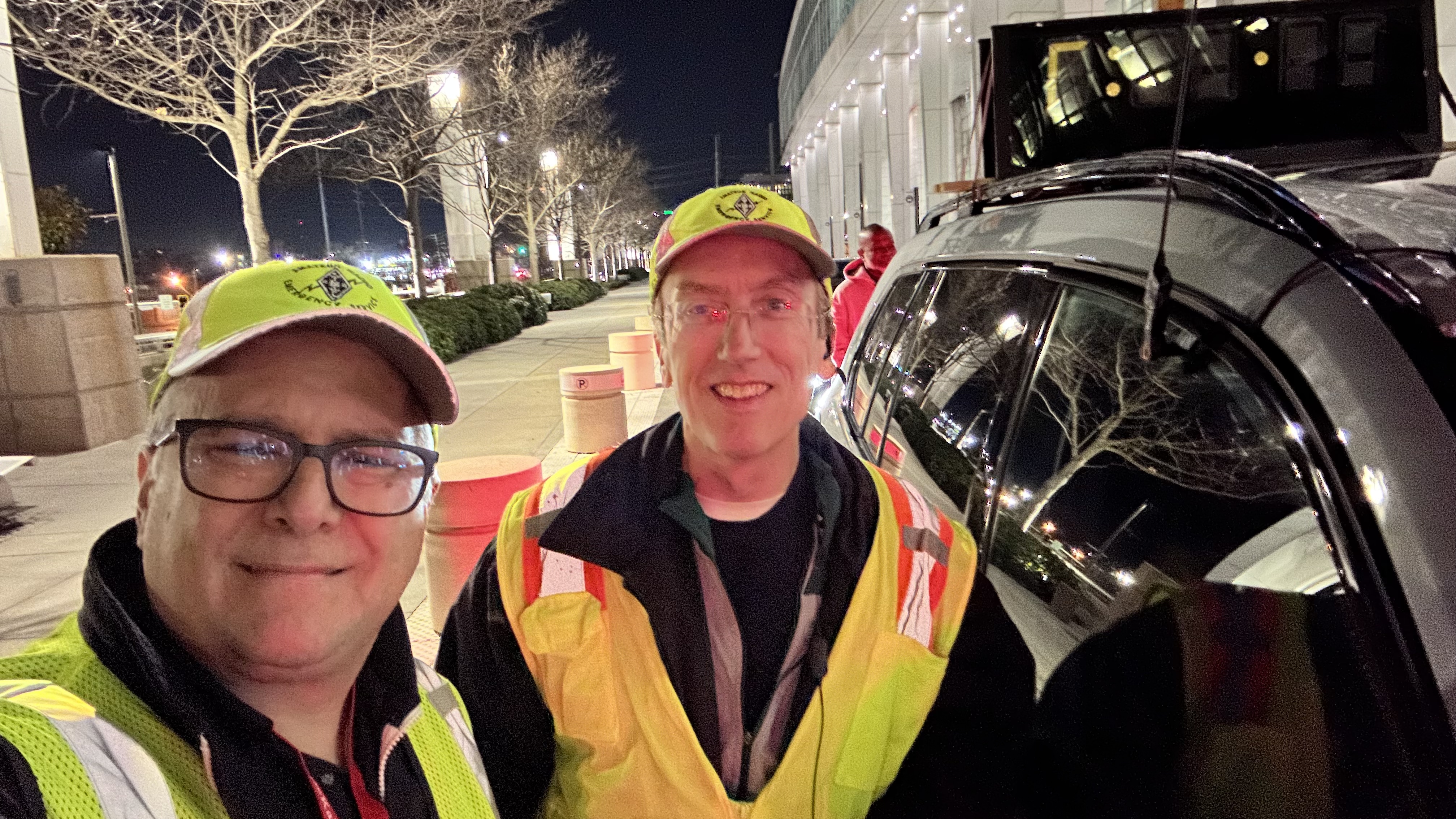
DeKalb ARES members supported situational awareness, net control, runner-shadow roles, SAG vehicles, and aid stations alongside neighboring ARES groups across metro Atlanta. Also the venue for the USATF Half Marathon Championship and a real-world test of cell-based APRS for fleet tracking — covered in the after-action discussion below.
What was on the air
The 2026 Atlanta Marathon was unusually high-stakes for a metro-Atlanta race: in addition to the marathon and half marathon itself, the half marathon doubled as the USATF Half Marathon Championship with a $20,000 prize purse. Net Control was Michael (KJ4GUY), with Elliott (KJ4CQJ) and Elliot (KK4LUK) as coordinators, and DeKalb ARES filled SAG, PACE, MOTO, MED, and AID station roles alongside neighboring ARES groups.
Reporting roles
A few stations had specific reporting tasks beyond runner-pickup dispatch:
- MED 1, MED 2, and AID MILE 20 logged Wet Bulb temperature readings every 15 minutes throughout the event. The Wet Bulb device was delivered with each station’s medical supplies in an envelope marked for the operator; AA batteries were a pre-event packing-list item.
- MED 2 doubled at the Start line during the wave starts, relaying each wave’s actual start time to the net before resuming SAG-drop-off / med-tent duties.
- Catrike on the half-marathon course — a self-propelled wheelchair starting ~5 minutes ahead of the runners and quickly outpacing them. AID stations on the half route were briefed to expect it; the higher the mile number, the further ahead of the runners it would arrive.
SAG operations
- SAG Drop-Off was at Northside Drive & Magnolia St., east side just north of the runners’ turn into the Home Depot Back Yard. A coned area was reserved. Northside congestion meant Magnolia was the recommended approach even if it added blocks.
- Backup drop-off: the Orange Deck entrance through to the NE corner of HDBY — only when the primary was inaccessible, since the deck route was usually congested too.
- SAG-7 SWEEP was the designated last-runner sweep for the first half, equipped with a special location tracker and instructed to stay at the back of the pack. If SAG-7 picked up a runner, another SAG was dispatched to relieve them.
- Muster was 5:30 AM at the track club warehouse, departing 5:45. PACE cars especially had to leave on time — start-line road closures wouldn’t wait. Recommended arrival was 5:15.
- Window mounts were required because the SAG vehicles were aluminum-bodied — magnetic mounts wouldn’t hold.
- AEDs were carried on every SAG and at every AID station.
Drivers also had a track-club commercial radio for situational awareness on the track club’s net, but every official ARES dispatch ran on the ham net.
APRS at the marathon — how it was used, what we learned
The 2026 marathon was — among other things — a real-world test of cell-based APRS as a tracking and dispatch tool for a moving fleet of public-service operators. Because RF APRS coverage in metro Atlanta is unreliable (insufficient iGate density at the time of the event), the deployment standardized on APRS-IS clients running over cellular data: APRS.FI on iPhone, APRSDroid on Android, with PinPoint APRS at Net Control showing the full operational picture on a map.
The setup
| Role | Tool / configuration |
|---|---|
| Net Control | PinPoint APRS on laptop, with the course KML imported as GPX — overlay of streets + closures + every operator on one screen |
| SAG vehicles | aprs.fi or APRSDroid on a phone, beaconing over cellular |
| PACE vehicles | Same as SAG |
| MOTO units | Phone-based APRS, voice dispatch primary |
| Aid stations | Some operators beaconing manually when staffing a downed runner |
Standard beacon rate was every 1 minute when moving and every 5 minutes when stationary, with a discussion (see below) about whether aid-station operators should beacon faster — or just hit “manual beacon” when they’re physically with a runner waiting for a SAG pickup.
What worked
- Net Control had a live map of the entire fleet. PinPoint APRS with the course KML loaded gave NC the ability to see exactly where every SAG, PACE, and MOTO was relative to closed roads and aid stations — a significant improvement over voice-only dispatch.
- Multiple comms paths to dispatch. RF voice, APRS text messages, and cell phone calls / SMS were all used during the event, providing redundancy when any one path was congested.
- Real impact on the ground. SAG-2 alone responded to about five dispatches and recovered four runners over the course of the event; similar volume across the other SAGs.
What we identified for next year
A detailed AAR thread between Scott Sheppard (KJ4ZZB), John DeRoo (K4VER), and a Moto rover, CC’d to the broader operations group, surfaced a clear set of action items for the 2027 race:
- Tighter beacon-rate convention. The “1-minute-moving / 5-minute stationary” default is reasonable, but aid-station operators who are physically attending a runner waiting for SAG pickup should either beacon faster or hit a manual beacon when they’re in position. SAG drivers reported difficulty spotting the operator in a crowd of finishers and bystanders even when the safety vest was visible.
- Net Control discipline + acknowledgments. Several SAG operators received dispatches via three channels almost simultaneously (RF voice, APRS text, cell SMS) and weren’t sure which to acknowledge or where the authoritative instruction lived. Going forward: one spoken RF dispatch as the canonical message, followed by an APRS text as a written reminder, with explicit APRS-text acknowledgment back to NC. MOTO and bicycle units skip the text — drivers can’t read while moving.
- Course route loaded into mobile clients. Net Control’s PinPoint APRS with the imported KML was hugely useful; replicating that on SAG/PACE iPads (cell-tethered, browser to aprs.fi with a custom KML overlay) would let drivers see the same picture and reduce confusion at unfamiliar intersections.
- Resources signal breaks to NC. Multiple cases where SAGs went off-net briefly without a status update, leaving NC unsure if they were available. Going forward, “Taking 10 to rest” / “Standing by” should be a standard transmission. Related: a porta-potty at the SAG drop-off zone would be a small but real improvement — crews on duty for the full event reported no realistic options between dispatches.
- Don’t micromanage the people on the ground. One SAG team had to park a block away from the official pickup intersection because of one-way streets and closures, and was repeatedly told over the radio to go to the original intersection while they were already walking the runner back to the vehicle. NC should default to trusting the situational awareness of the resource on scene unless there’s an overriding reason not to.
- Beyond APRS — explore RTRT.ME. The Atlanta Track Club uses RTRT.ME (RFID-based) for runner tracking, heat maps, and some operational fleet visibility. Worth investigating whether it could absorb more of our resource-tracking needs in a future race, particularly if RFID tags can be issued to SAG/PACE vehicles. Long-term option, not near-term — initial conversations with track club management are pending.
How the marathon influenced subsequent DKARES infrastructure
The thin RF APRS coverage in metro Atlanta surfaced during this event was a direct contributor to DKARES standing up its own deployable APRS digipeater/iGate (W4BOC-1) — first as a portable asset for the March 21 county coverage drill, then as a permanent fixture on Stone Mountain after the drill validated the site.