Member Projects
A running index of builds that DeKalb ARES members put together on their own bench and bring to the group. Some are polished, some are works in progress. First up is a portable digital station that packs APRS, Winlink, and packet into a Raspberry Pi you can run off a solar panel or a pocket battery.
DigiPi field-deployable digital station (KJ4ZZB)
Scott Sheppard (KJ4ZZB) has been building out a family of portable digital stations around DigiPi, an open-source Raspberry Pi image for amateur-radio digital modes. Each station is a small box that pairs a Raspberry Pi with a handheld radio and a GPS, and puts a full digital toolkit behind a web page you reach over the station's own Wi-Fi. The design comes in four flavors, from a solar-powered field-day rig that runs indefinitely down to a pocket-sized unit you can carry in a go-kit.
What it does
Every model runs the same DigiPi software and is driven from a browser over Wi-Fi. From that one interface an operator can:
- Show a live map of the area and beacon its own position to the internet over APRS.
- Send a text message to a cell phone through the radio and an internet gateway.
- Send a text to other APRS stations.
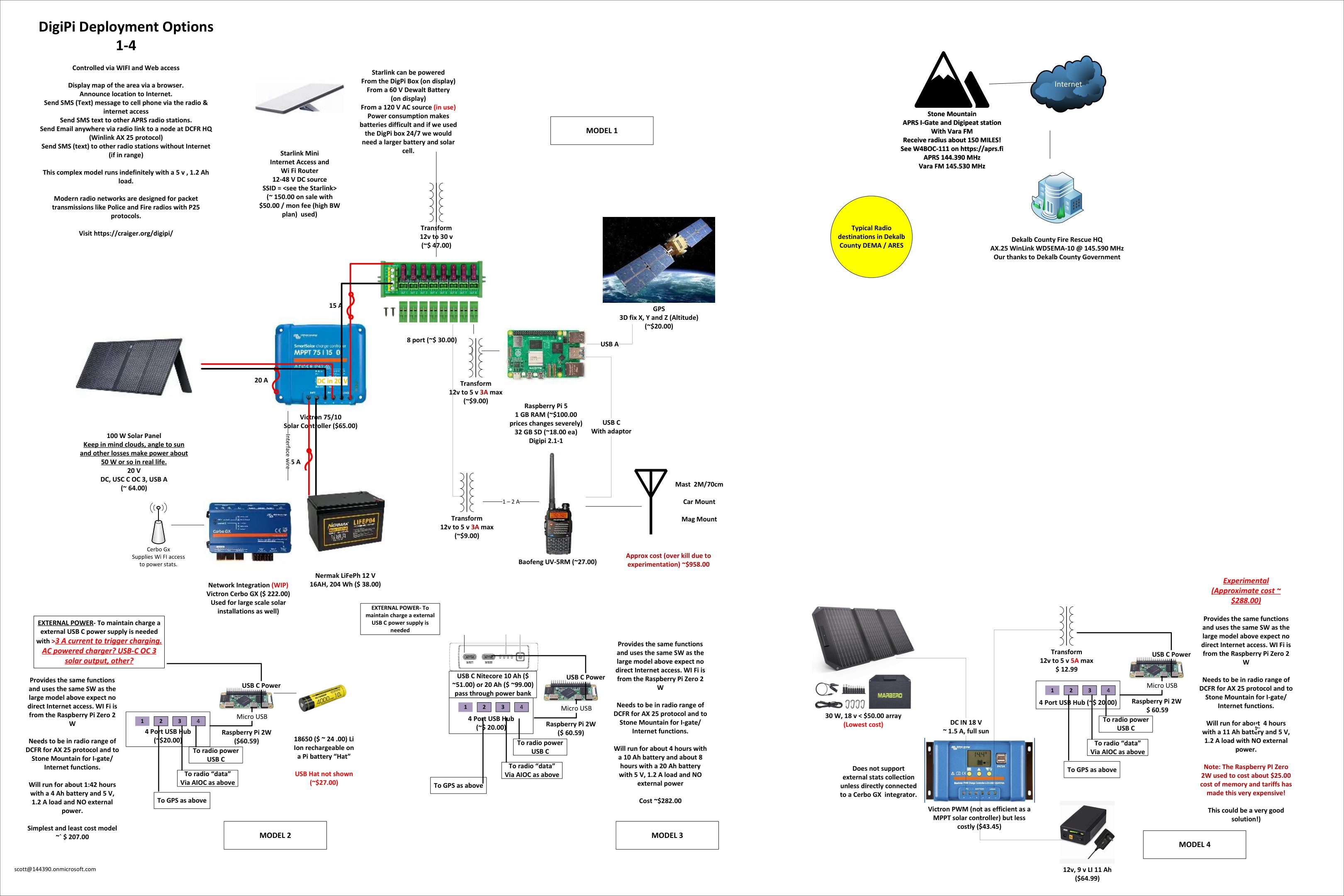
- Send email anywhere over a radio link to either DeKalb ARES packet node. Both answer as WD5EMA-10, because the -10 SSID means packet: DeKalb County Fire Rescue HQ on 145.590 MHz, or Stone Mountain on 145.530 MHz (AX.25 packet on both).
- Pass short text to other radio stations with no internet at all, simplex, as long as they are in range.
The four models
All costs below are Scott's rough parts estimates and include a fair amount of experimentation.
- Model 1 - full field-day rig (~$958). A Raspberry Pi 5 running DigiPi 2.1-1, fed by a 100 W solar panel through a Victron 75/10 MPPT controller into a Nermak LiFePO4 12 V 16 Ah (204 Wh) battery, with a Victron Cerbo GX for power monitoring and a Starlink Mini for internet and Wi-Fi. Adds GPS, a Baofeng UV-5RM, DC-to-DC converters, and a 2 m / 70 cm mast antenna. Solar-sustained, so it runs indefinitely at its ~5 V, 1.2 A load. Scott flags this one as overkill, built for experimentation.
- Model 2 - simplest and lowest cost (~$207). A Raspberry Pi Zero 2 W and a 4-port USB hub running off an 18650 Li-ion cell on a Pi battery HAT. No direct internet; Wi-Fi comes from the Pi itself. Runs about 1 hour 42 minutes on a 4 Ah battery with no external power.
- Model 3 - power-bank portable (~$282). The same Pi Zero 2 W build powered by a Nitecore USB-C pass-through power bank, 10 Ah (~$51) or 20 Ah (~$99). Runs about 4 hours on the 10 Ah pack or 8 hours on the 20 Ah pack with no external power.
- Model 4 - experimental small-solar (~$288). A Pi Zero 2 W build fed by a low-cost 30 W, 18 V solar array through a Victron PWM controller (cheaper than MPPT, a bit less efficient) into a 12 V, 11 Ah Li battery. Runs about 4 hours on the battery with no external power. Scott notes this could be a very good solution.
Models 2 through 4 share the same wiring: the Pi drives the radio's data over an AIOC (all-in-one cable) and its power over micro-USB, with GPS on the hub. They have no internet of their own, so to reach the wider network they need to be in radio range of DeKalb County Fire Rescue HQ for AX.25 Winlink and of Stone Mountain for the APRS I-gate.
Where it connects
- Stone Mountain APRS I-gate and digipeater - the club's W4BOC station with Vara FM, a receive radius of roughly 150 miles, visible on aprs.fi. APRS on 144.390 MHz, and on 145.530 MHz both Vara FM as WD5EMA-15 and, since October 2026, AX.25 packet as WD5EMA-10. It also digipeats in both modes as WD5EMA-4.
- DeKalb County Fire Rescue HQ - the WD5EMA-10 AX.25 Winlink node on 145.590 MHz. Thanks to DeKalb County Government for hosting it.
Want the full detail? Open Scott's complete schematic (PDF), or read up on the base software at craiger.org/digipi.